
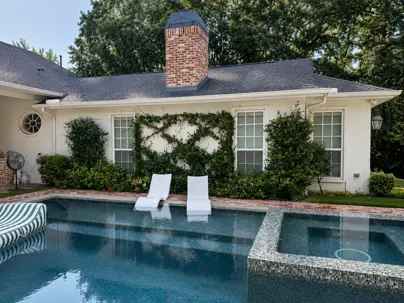
We talk with homeowners every week who are trying to figure out what is going on with their pool. Sometimes the problem is simple, such as a dirty basket, low water level, or an incorrect setting. Other times, it involves the pump, heater, plumbing, automation, or another part of the pool system that needs to be professionally inspected.
Pools in The Woodlands and Spring, TX can be incredibly complex. Many feature custom attached spas, intricate water features, advanced heaters, salt systems, automation, and multiple pumps. When one part of the system is not working correctly, it can quickly cause a domino effect across the entire setup.
Here are 10 of the most common pool repair questions we hear from homeowners in The Woodlands, Spring, and the surrounding areas.
1. Why Is My Pool Losing Water?
Every pool loses some water to evaporation, especially during the scorching summer months in Southeast Texas. Water features, active swimmers, wind, and routine backwashing can also lower your water level. However, if you find yourself constantly adding water, you likely have a pool leak.
Signs of a pool leak include:
- The water level drops rapidly (more than a 1/4 inch per day).
- The auto-fill valve runs constantly.
- The equipment pad stays wet or has standing water.
- The pool pump keeps losing prime.
- You notice air bubbles blowing out of the pool returns.
- The ground near the pool or equipment pad is unusually soft, soggy, or wet.
- Your monthly water bill spikes unexpectedly.
The Fix: You can perform a simple "bucket test" to compare natural evaporation against actual water loss. If the pool level drops faster than the water inside the bucket, it’s time for a professional pool leak detection. Finding the source early prevents soil washout, deck movement, landscaping damage, and soaring chemical costs.
2. Why Won’t My Pool Pump Turn On or Prime?
Your pool pump is the heart of your pool, responsible for moving water through the filter and keeping the system clear. When it stops working, a pool can turn cloudy or green in a matter of days.
Common pool pump issues include:
- The pump will not turn on at all or trips the circuit breaker.
- The motor hums loudly but refuses to start.
- The pump runs but fails to move water or regularly loses prime.
- The motor makes a loud screeching, whining, or grinding noise.
The Fix: Sometimes the issue is a simple fix like a low water level, a clogged skimmer basket, a closed plumbing valve, or a dirty filter. However, it can also be caused by a suction-side air leak, a clogged impeller, a failed capacitor, or a completely burned-out motor. Never let a pool pump run dry. Running without water quickly destroys the pump seals and internal components. If it repeatedly trips the breaker, shut it off and call a technician.
3. Should I Repair or Replace My Pool Pump?
Whether you should repair or replace a pool pump depends entirely on the age, overall condition, and efficiency of the existing unit.
- When to Repair: A repair makes perfect sense if the pump is relatively new and the issue is isolated to a cheap, replaceable part—such as a shaft seal, O-ring, capacitor, or a single valve.
- When to Replace: Replacement is the smarter long-term investment if the motor has completely failed, the plastic housing is cracked, the unit runs incredibly loud, or parts are obsolete.
The Variable-Speed Advantage: Many homeowners in our area are upgrading older single-speed pumps to energy-efficient variable-speed pool pumps. These allow you to run the system at lower, whisper-quiet speeds for daily filtration, and ramp up the RPMs only when operating a spa, heater, or waterfall. They drastically cut electricity costs and offer far better control over your entire system.
4. Why Isn’t My Pool or Spa Heater Working?
Pool and spa heaters are sophisticated appliances, and when they fail to ignite, the problem actually often lies outside the heater itself.
Common heater complaints include:
- The heater will not ignite or starts up and immediately shuts down.
- The digital display shows a "Service Heater" or "Low Flow" error.
- The spa takes an unusually long time to heat up.
- The heater refuses to respond to the pool automation app.
The Fix: Heaters require strict, consistent water flow to operate safely. A dirty filter, a clogged pump basket, a low variable-speed pump setting, or an incorrectly turned valve can trip safety switches and prevent ignition. Internal culprits include failed sensors, corroded pressure switches, faulty control boards, or scale buildup inside the heat exchanger. Because these units combine high-voltage electricity, gas lines, and extreme heat, troubleshooting should always be left to a professional.
5. Why Isn’t My Pool Automation or Phone App Working?
Modern pool automation makes backyard management incredibly convenient—until the app stops communicating.
Common automation issues include:
- The smartphone app displays an "Offline" or connection error.
- Programmed schedules completely disappear.
- Valves fail to turn when switching into spa mode.
- Lights or water features refuse to turn on remotely.
The Fix: First, determine if the issue is a network problem or an equipment problem. Walk out to the physical, outdoor control panel on your equipment pad. If the pumps and lights operate perfectly from the manual buttons but fail on your phone, you are likely dealing with a Wi-Fi signal drop, a failed wireless antenna, or a router communication error. If the buttons on the panel don't work either, the issue points to a failed relay, an actuator problem, or a blown motherboard.
6. Why Is My Saltwater Pool Not Producing Chlorine?
A common misconception is that saltwater pools don't use chlorine. In reality, a saltwater system uses a process called electrolysis to turn dissolved pool salt into pure chlorine. When the system fails, your water will quickly turn dull, cloudy, or green.
Watch out for these salt system diagnostic alerts:
- "Low Salt" or "Inspect Cell"
- "No Flow" or "Check System"
The Fix: Low chlorine production can be triggered by a calcified salt cell, low water temperatures (most systems stop generating below 60°F), insufficient pump speeds, or a worn-out cell at the end of its 3-to-5-year lifespan. Always manually test your water before adding salt. A malfunctioning control board or a dirty cell can give a false "Low Salt" reading, and adding unnecessary salt can overload the system or require you to partially drain the pool to fix it.
7. Why Does My Raised Spa Drain Into the Pool?
This is a classic plumbing issue unique to backyard pools with elevated or raised spas. The spa remains completely full and spills over beautifully while the pump is running, but within hours of the system shutting off, the water level drops significantly—sometimes draining entirely back into the pool overnight.
The Fix: This is almost always caused by a failed or dirty check valve on the spa return line. When the pool pump turns off, gravity naturally wants to pull the water down from the elevated spa into the lower pool. A check valve is designed to act as a one-way gate to stop this backward flow. If a small piece of debris gets caught in the valve flap, or if the internal rubber seal degrades, water will slowly siphon backward.
8. Why Aren’t My Pool Lights Working?
Pool lighting issues can range from a single dead bulb to a completely unresponsive system that flips a breaker the moment you flick the switch.
Common lighting failures include:
- Lights flicker, display incorrect colors, or fall out of sync.
- The GFCI outlet or circuit breaker trips immediately when turned on.
- Water is visible inside the lens fixture.
The Fix: If multiple lights throughout the pool stop working simultaneously, the issue is rarely that every bulb burned out at once; instead, look for a tripped GFCI outlet, a failed transformer, or a bad automation relay. If a single light is causing the breaker to trip, water has likely breached the fixture's rubber gasket. Because mixing water and electricity carries extreme safety risks, never operate a pool with a known electrical shortcut or unsealed lighting fixture.
9. Do Stains, Cracks, or Rough Plaster Mean My Pool Needs to Be Resurfaced?
Not every surface imperfection requires a massive renovation project, but understanding the root cause is critical to protecting the structural integrity of your pool.
- Stains & Discoloration: Dark, rust-colored, or organic stains can often be treated, minimized, or entirely removed using specialized chemical treatments or a carefully monitored professional acid wash.
- Rough Textures: Rough plaster or white calcium scaling is usually the result of long-term unbalanced water chemistry. While an acid wash can smooth out minor scaling, it strips a thin layer of plaster away and shouldn't be done excessively.
- Cracks & Delamination: If you notice plaster flaking off, "hollow" spots behind the walls, or deep cracks that are actively expanding or leaking water, the pool finish has reached the end of its lifespan and needs to be fully resurfaced.
10. How Do I Protect My Pool During a Texas Freeze?
Hard, freezing weather doesn't happen every week in Southeast Texas, but when a severe cold front drops into the region, pool equipment can suffer catastrophic, expensive damage in a matter of hours.
Unprotected freeze damage can lead to:
- Cracked plastic pump housings and shattered filter tanks.
- Burst copper pipes and split PVC valves.
- Ruptured internal heater headers.
The Fix: Modern automation systems are equipped with automatic freeze protection that turns on the pumps when ambient temperatures approach freezing to keep water moving (since moving water cannot easily freeze). However, you must verify that all critical pumps—including separate water feature pumps, booster pumps, and spa circuits—are actively programmed into that freeze protection sequence.
Emergency Winterization Tip: Freeze protection relies entirely on the electrical grid. If a major winter storm knocks out power to your home, you must immediately head out to the equipment pad, pull the drain plugs on your pumps, filter, and heater, and open the air relief valves to manually drain the water out before it expands and cracks your equipment.
When Should You Call a Professional Pool Repair Company?
While cleaning out a packed skimmer basket or adjusting a dirty filter can easily be handled on a weekend afternoon, major system diagnostics require specialized expertise. It is time to call in a professional if:
- The pool has an active leak or won't hold water.
- The pump motor refuses to prime, hums, or screeches.
- An electrical breaker or GFCI outlet keeps tripping.
- Water is actively dripping or spraying from equipment seals.
- The automated control board or smartphone app goes completely unresponsive.
Professional Pool Repair in The Woodlands, TX
At One Source Residential Services, we specialize in providing high-quality, dependable pool diagnostics and repairs throughout The Woodlands, Spring, and Conroe. Our experienced technicians focus entirely on finding the true root cause of your system's issues, giving you a transparent diagnosis and a clear, reliable recommendation.
We believe in delivering lasting value—meaning we don't believe in replacing equipment until we fully understand why it is not working. Our goal is to restore the safety, efficiency, and comfort of your pool system so you can get back to enjoying your backyard oasis.
For expert pool repair in The Woodlands, Spring, and Conroe, TX, call One Source Residential Services at 281-363-4663 or visit us online at www.askonesource.com to schedule your diagnostic visit.
We proudly serve homeowners across The Woodlands, Spring, Conroe, Shenandoah, Magnolia, and Montgomery.